

How We Help Businesses and Web Host Admins Migrate, Secure and Upgrade their Websites and Applications from cPanel, Plesk, WIX, Godaddy, AWS, GCP, DigitalOcean, OVH, Hostinger

Lately we’ve been getting hit with a flood of new customers and projects relating to more traditional “shared web hosting”. A lot of companies still use this method for hosting their sites and web applications because in theory it is simple, effective and sometimes affordable, but often not reliable, well performing or secure. It can also be very negative for SEO and marketing when you share an IP with other bad or similar good sites.
Out of my own conscience and when Virtualization and Dedicated Servers have become so affordable over the years, my company has not offered web hosting for probably 20 years, even though we are experts in this area too. We’d rather offer a helpful and ethical product rather than load up thousands of customers on a shared server.
Understanding the Tenant, Landlord Relationship in web hosting
A lot of our clients aren’t aware of the differences, they see plans that say “unlimited sites” and X GB of storage, etc.. and 99.9% reliability promises and the marketing makes you think “why pay more for unnecessary Virtual Machines or Dedicated Servers?”. Many times, web hosting is actually not cheaper or not much cheaper compared to a VM, which is the lowest tier I can justify selling or even my best friend using for their business.
But first before comparing I have to explain the differences between Shared Web Hosting, VMs and Dedicated Servers and I’ll be explaining it backwards.
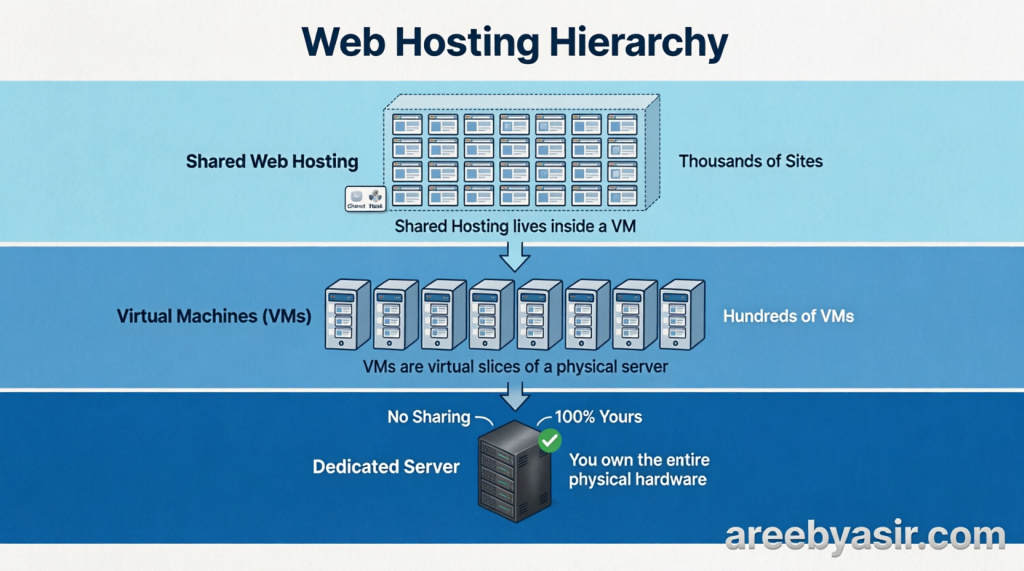
We have to understand the “base service” of anything online is a physical server, that means your shared hosting is usually running on a VM (Virtual Machine) on a physical Dedicated server. Dedicated Servers will usually have dozens of VMs running on them, which means the VMs are already fighting for and sharing resources with the other VM tenants.
Once you get to “web hosting”, generally this means it is something like cPanel or Plesk that gets installed to a VM. Then your web host just sells hundreds of thousands of accounts on that same VM. So Shared Hosting is essentially the worst level to be at, because you are competing within the same VM and the VM your host has, is competing against possibly dozens or hundreds of other VMs.
The diagram below shows what I’ve just described:
Why don’t we offer “web hosting”?
Shared Hosting does not have consistent performance
In most cases hosts are just using an already shared VM, which is already competing with other VMs on that same Dedicated Server for performance and processing power. Shared hosting on a shared VM setup, just makes performance issues even worse, or at best, very hard to get consistent and reliable performance.
I find it unethical to offer hosting in this way because there is no way to offer “Unlimited websites” on even a higher spec VM without running into performance issues. Even if that VM does nothing, most server companies load up the “Dedicated Server” with at least dozens of VMs so your performance is already limited in that way.
This means that it’s harder to get consistent and reliable performance when you have so many layers of sharing involved. You could be slowed down by other sites on the same VM and if it’s not that, other VMs on the same Dedicated Server could slow down the VM that is doing your web hosting.
Shared Hosting is Insecure
Aside from the performance issues that come with Shared Hosting, remember that you are directly sharing the same server/VM, usually with hundreds or thousands of other sites. This means rather than the risk that your site gets DDOS’d or hacked, your risk is exponentially higher because any of the other web hosting clients could create the same issue for you. Yes, generally Plesk and cPanel try to isolate each customer, but it’s not fool proof or perfect and there are many ways hackers can and have gotten access to all data and clients on a single web hosts’ server.
If your host is hacked, it may not just stop at all the sites on that server, a lot of hosts also combine e-mail into the same server, so if you are using e-mail it’s possible that the hackers can read all of your existing and new e-mails. This is especially dangerous if the e-mail is used for 2FA for things like banking or crypto exchanges.
Shared Hosting can Cause SEO Issues
It is common that your website’s IP may be shared with hundreds or thousands of other sites. Aside from the concerns over hacking, there are SEO issues to think of such as Google’s Diversity Filter and PBN Filters being triggered. You have no control over whether your IP is shared with hackers, criminals or even other similar businesses. If there are similar businesses that are a client of your web hosting company, then we’ve seen it often that only 1 company may rank on that IP. For example if you are a “top lawfirm” and the web host has 200 other lawfirms, only 1/200 lawfirms may actually rank for those types of keywords which means you lose 100% of search traffic because you used a shared IP.
The other problem with shared hosting is that if your site starts responding slowly because it is being shared with so many other sites, your rankings in search engines like Google will suffer since they do not like to rank unreliable or sites with poor performance.
Don’t agree with us?
We realize not everyone agrees with us, but my professional and ethical opinion is that Shared Hosting just doesn’t make sense to offer even though it likely has some of the higher profit margins.
How do we offer web hosting and help our clients?
Migrations
We do a lot of migrations from other platforms whether Plesk/cPanel, GoDaddy, Hostinger, WIX, Squarespace etc.. clients come to us when they want guaranteed performance, more reliability and better security because we do it right. We’ve migrated them to our own proprietary platform where necessary or sometimes they just prefer to have their own Dedicated Plesk or cPanel server and that works well.
We keep our share of sites and applications up, but we normally do it through VMs and Dedicated Servers, so in all cases their application will run on a VM or Dedicated Server(s). We don’t overload our servers with hundreds of VMs like others and if customers need guaranteed consistent performance, we advise them to get a Dedicated Server setup, and a Cluster if their budget allows.
For our enterprise clients we often help them turn their applications or at least their databases into a highly performing, distributed database to maximize performance and uptime. Combined with that, we can increase security by using our own platform by containerizing all of their websites/applications into Docker or Kubernetes clusters and by keeping the container read-only, makes it nearly impossible for hackers to access or gain control of their container(s), since containers have no direct access beyond the application they need to serve.
We can also couple that setup with a transparent private CDN to increase performance. Some of our clients have gone from being able to handle dozens or hundreds of users per second on their site to literally thousands, in the case that their content is fully cacheable.
In fact, half the time we find that sometimes we downgrade customers after they move to our fully cached CDN service. I’m very proud of these types of migrations and setups, because the customer comes out if with a better, more secure and highly performing service than they came from.
Conclusion
Most web hosting companies can sell you hosting, but they can’t help you containerize and secure your applications or setup a private CDN for you. They offer shared hosting and it is true that some shared hosts offer VMs and Dedicated Servers but we recommend against those types of hosts, because they tend to attract much more abusive users in terms of DDOS and actual criminals. Generally the easiest, quickest and cheapest way to get a site, VM or Server online is what criminals and hackers are looking.